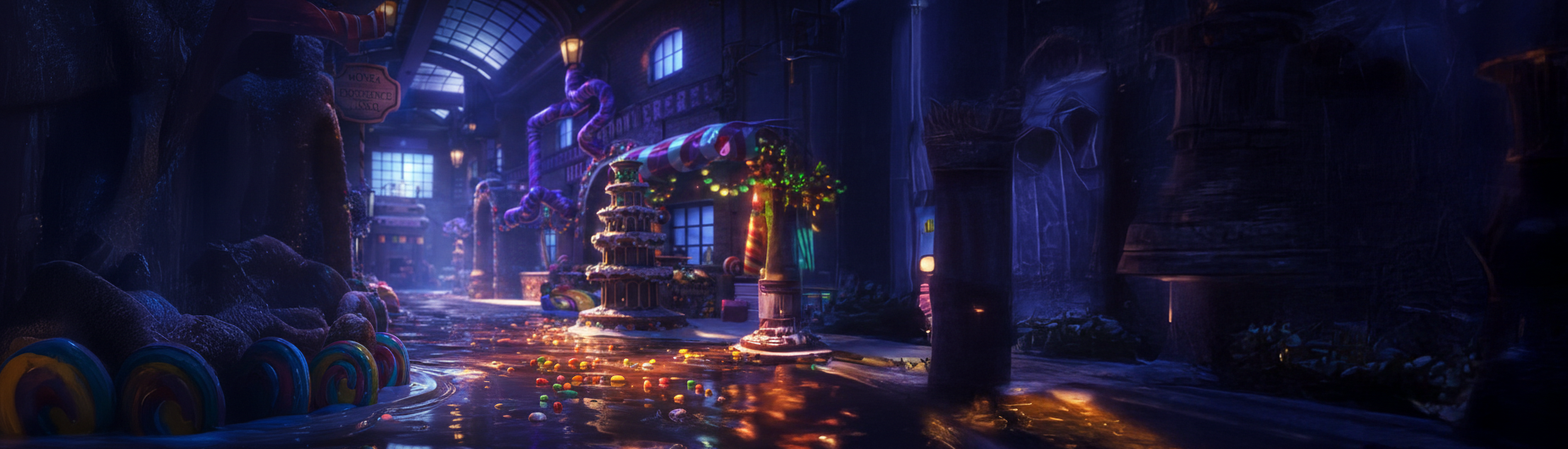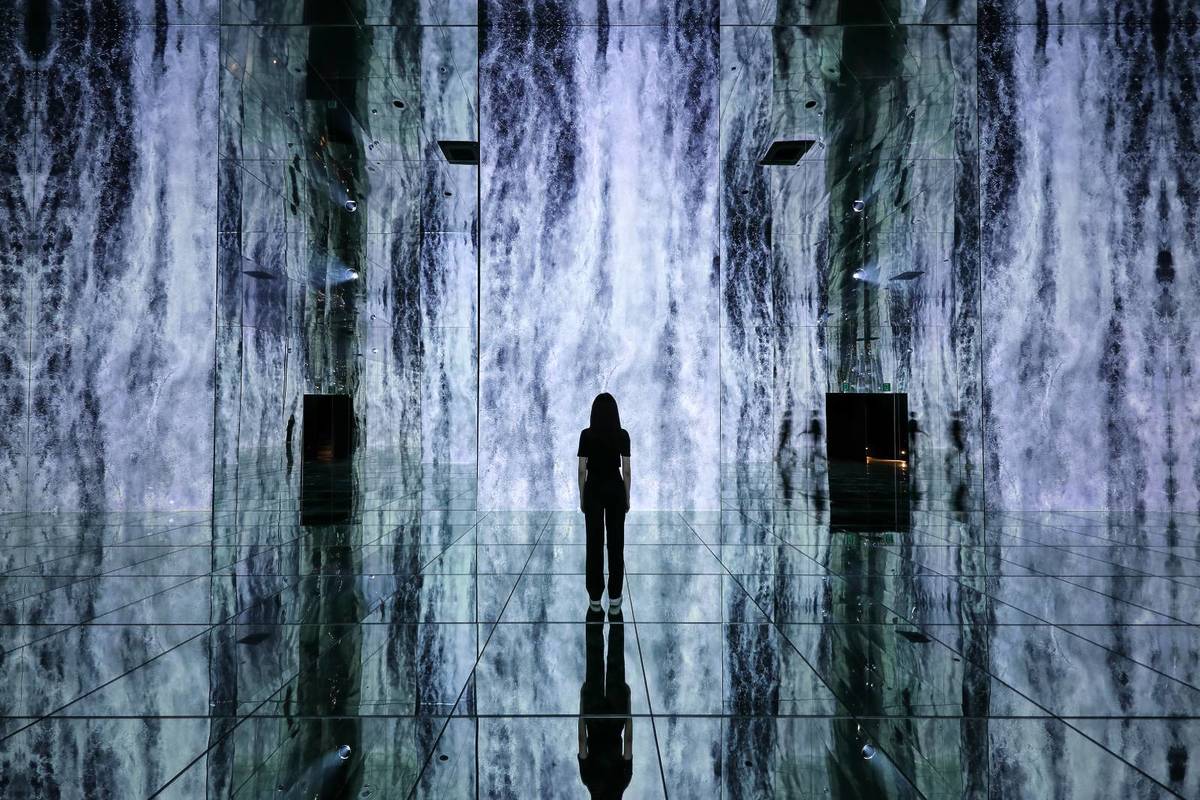
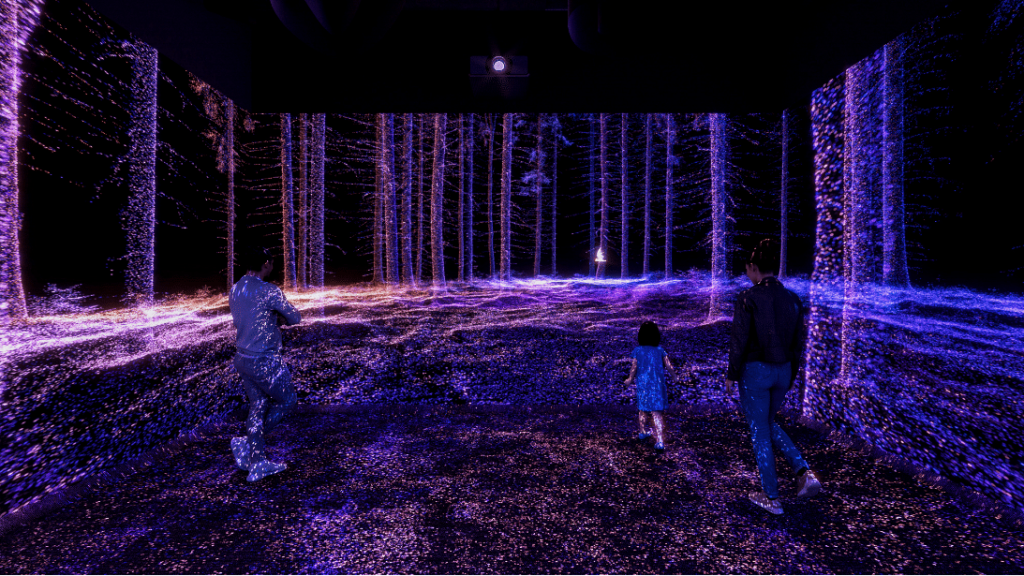
You step into a dim room. The floor glows like wet earth after rain. The sound isn’t a soundtrack, it’s weather moving around you. There’s a scent you can’t quite name until your brain catches up: petrichor, green and mineral. No headset. No earbuds. No instructions barking at you. Just your breath settling into the same rhythm as the room.
That’s the basic promise of Sensory Odyssey: Not a museum exhibition with labels and walls of text, but a multisensory experience with an intuitive flow that helps you feel present, curious and quietly awake to the living world.
Sensory Odyssey
A playful, learning-led experience in co-production with the National Museum of Natural History, France that uses large-format imagery, spatial sound and scent to reconnect people with the non-human world. It’s a traversal more than a tour: you don’t accumulate facts, you gather sensations that stick and make you want to learn more after. Two core beliefs sit under it:
- Immersion starts in you. When breath, posture and attention sync with light, sound, temperature and smell, your mind does the rest.
- Technology should get out of the way. The gear is there, but it doesn’t audition for a role. Presence beats showmanship.
The myth to retire: more tech ≠ more immersion
If you’ve ever been told that immersion lives inside a headset, Sensory Odyssey disagrees. The team’s position is blunt: “Real immersion happens in the body and the mind, when you’re in sync with the environment.” That’s why there are no devices such as helmets, no earbuds, no individual screens. Your peripheral vision stays open, your breathing unclenches and you can see other people sharing the moment. Co-presence is part of the script, not a distraction.
When it’s right, you feel the scene more than you see the fixtures.
Why visitors remember more (the wonder engine)
Sensory Odyssey favors an almost non-verbal approach. It tries to land awe and wonder first, because wonder doesn’t make you passive, it nudges you to ask how and why. Psychologists have been pointing this out for years: curiosity sustains attention and helps memory consolidate. In practice, visitors report feeling calmer, more empathetic and more open to reading and acting after the experience. You exit with your mind switched on, not switched off.
Scent is the spine, not decoration. Most science experiences lean heavily on the eyes: text blocks, diagrams, screens. That can exclude or exhaust a lot of people. Sensory Odyssey flips the weight: scent and sound carry the story, with images supporting. The original scents were produced in partnership with IFF, exclusive partner of the fragrances, whose perfumers and scientists helped translate ecological realities into precise scent signatures that feel both true and grounded in the living world of Sensory Odyssey.
Why scent?
- It has a direct route to the parts of the brain that process emotion and autobiographical memory.
- It anchors you in the scene and gives the visuals a tactile truth.
- Distinct scent signatures act like trail markers. Later, they help you retrieve the feeling of a moment without needing a paragraph of text.
But what about allergies, strong smells, or fatigue?
The design rules are strict:
- Fewer scents, clearly identifiable, always tied to what you see or hear.
- Dry-molecule diffusion with very low persistence, so smells don’t linger or muddy together.
- Sound-and-light transitions between rooms to neutralize the previous scent.
- Processes meet stringent hygiene standards and are selected to avoid allergen risk as deployed.
Short version: low dose, high clarity, clean transitions.
Sound is the guide you don’t notice
Instead of blasting music, the space uses spatial audio to shape how you move and feel:
- Low, steady beds slow you down and lengthen your gaze.
- Brighter, directional cues tilt attention without bossing anyone around.
- Silence is purposeful, it lets images land.
You come out saying “I felt like I was inside it,” not “a voice told me where to look.”
Accessibility and cognitive comfort, by design
The overall effect is soothing, not sensational:
- Moderate sound levels, soft light contrasts
- Regulated crowd density and gentle pacing so bodies have time to inhabit each scene
- No fiddly gear to adjust
For neurodivergent or sensory-sensitive visitors, there are progressive transitions and pause zones. The aim isn’t to impress you into silence, it’s to restore a natural sense of being somewhere now.
What the team measures (and why it matters)
In May–June 2022, during a pilot at the Muséum national d’Histoire naturelle (Paris), the team ran an on-site study combining:
- Lightweight EEG (4 electrodes at FP1/FP2)
- Questionnaires on presence, flow, “small self,” emotion, connection to nature, sublime
- Observation of how people moved and paced themselves
The guiding question was simple: do moments of awe and wonder align with physiological signs of calming (for example, more regular breathing)? The study, built with a transdisciplinary group (CNRS, MNHN, EHESS, Université Paris Cité, CRNL Lyon, Monell Center), was described as a first-of-its-kind experimental frame for an immersive experience. Findings fed back into pacing, light/sound levels and transitions, in pursuit of immersion that feels natural rather than dictated by tech.
Where the tech belongs
By principle, tech steps back:
- Projectors (4K/8K), surround sound and scent diffusers are integrated and quiet.
- Cables, LEDs, and control interfaces are out of sight.
- The environment gets to be the lead actor, the infrastructure and equipment disappear.
Gwenaël Allan, Founder of Sensory Odyssey says: “Here, spectacle and imagination take precedence to make science more appealing. The techniques, technologies and creativity we deploy all serve one aim: to compose a world that gives the illusion of perceiving, seeing, hearing, smelling and feeling the living world as if we were endowed with the powers of other non-human species. Changing perspective, feeling very small and being touched by the abundant richness and complexity of other species makes you want to respect, protect and learn from and contemplate in awe and wonder the non-human world.”
Why this isn’t just “nice to have”
If you’ve ever left a museum tired from reading, you know the problem. Sensory Odyssey tries to re-pattern attention: less extraction from your eyes, more participation from your whole body. That shift can help mend frayed bonds between humans and the more-than-human world, not through argument, but through experience. People leave more grounded and more ready to learn.
Original Narratives vision
Sensory Odyssey points to a future we deeply believe in: experiences that do not overwhelm, instruct or isolate, but re-tune our attention to the world. When immersion is grounded in the body and shared in space, learning becomes durable, emotion becomes meaningful, and technology finally takes its rightful place in the background.
At Original Narratives, this is the horizon we are working toward. Creating cultural experiences that begin with presence, awaken curiosity through wonder, and leave visitors more awake to history, nature and to themselves. Not by adding more layers of spectacle, but by designing moments that feel true, embodied and alive.
The ambition is simple and demanding at once:
- Create spaces where people do not just see a story,
- Feel and live them first-person
- And carry that feeling back into the world.
Learn more about Sensory Odyssey’s on their Webpage, LinkedIn and Instagram Pages
Learn more on Muséum National d’Histoire Naturelle and IFF
Sync with our vision here.
Image credits: Projectiles / Mardi 8 / Expéditions Spectacles / Sensory Odyssey